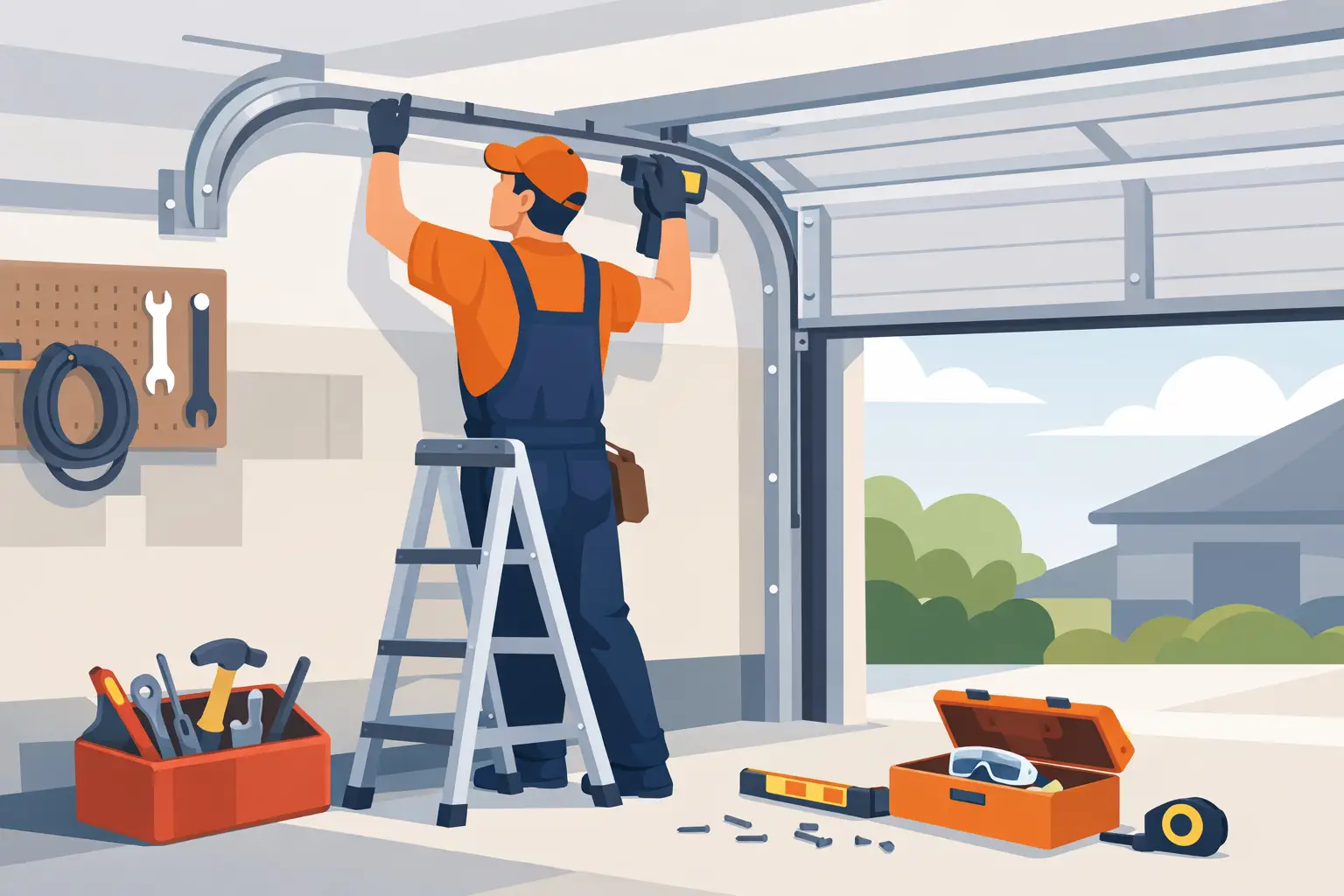
A garage door can be heavy, awkward, and unforgiving when its track is even slightly out of position. If you are researching how to install a garage door track, treat alignment as the job, not a finishing detail. A track that looks straight but is mounted at the wrong width, height, or angle can bind the rollers, damage the opener, and create a serious safety risk.
For Chicago-area homeowners and property managers, this work also has to stand up to daily use, temperature swings, and the vibration of a large moving door. Track installation is manageable only when you are replacing like-for-like components on a door that is fully supported and disconnected from spring tension. Installing tracks as part of a new door system, or correcting a door that has come off track, is usually a professional job.
Know What the Garage Door Track Does
A standard sectional garage door uses two track assemblies. The vertical tracks run beside the door opening. At the top, curved sections guide the rollers into horizontal tracks that run back toward the garage. Flag brackets, jamb brackets, rear hangers, rollers, cables, springs, and the opener all work around this path.
The tracks do not carry the door’s full weight by themselves. The spring system counterbalances that weight, while the tracks guide the rollers. That distinction matters. If springs, cables, or bottom brackets are under tension, do not loosen or remove them to make a track fit. Those components can release force suddenly and cause severe injury.
Before buying parts, confirm whether your door uses standard-lift, low-headroom, high-lift, or commercial hardware. Track radius, track length, bracket locations, and horizontal-track slope vary by system. A universal-looking piece of track is not necessarily compatible with your door.
When Track Installation Should Be Left to a Pro
There is a clear line between installing replacement track hardware and working around a loaded garage door system. Stop and schedule service if the door is hanging, a cable is loose or wrapped around a drum, a spring is broken, the bottom roller has come out, or the track is bent near the bottom bracket.
The same applies to torsion spring systems. Torsion springs sit above the opening and are tightly wound. Adjusting the cable drums, set screws, or spring tension is not a do-it-yourself track-installation step. Extension-spring doors also have stored energy and require the correct safety cables and hardware.
Commercial doors deserve additional caution. Their tracks, springs, and sections are larger and heavier, and downtime can affect deliveries, security, and tenant access. A qualified technician can match the track system to the door’s weight and usage cycle rather than making a repair that fails under daily operation.
Prepare the Opening and Gather the Right Materials
Start with the door closed, secured, and disconnected from the opener. If the existing door is not stable in the opening, do not proceed. Never rely on the opener rail or a clamp alone to hold a damaged door in place.
For a straightforward replacement of an undamaged track section, you will generally need the manufacturer-approved vertical and horizontal tracks, curved track sections, matching brackets, lag screws, nuts, bolts, and rear hangers. You will also need:
- A tape measure and level
- A socket set or wrench set
- A drill with appropriate bits
- Locking pliers and C-clamps
- Safety glasses and work gloves
- A step ladder rated for the work
Inspect the wood jambs, steel framing, and ceiling structure before mounting anything. Lag screws need solid framing, not cracked trim or weak drywall. Rear hangers must fasten into structural ceiling members. If a previous installer used improvised perforated strap, loose anchors, or mismatched bolts, replace that hardware instead of building on it.
How to Install a Garage Door Track: Vertical Sections
Install vertical tracks one side at a time, following the measurements in the door manufacturer’s instructions. The track should be parallel with the door jamb, but it should not press tightly against the door. Rollers need a small, consistent amount of side clearance to travel freely.
Attach the jamb brackets to the track first, then position the assembly against the jamb. Begin with the lower bracket and work upward, keeping the fasteners only snug enough to allow adjustment. Use a level to check that the vertical track is plumb. Measure from the track to the door edge at several points so the spacing stays consistent from bottom to top.
Do not assume the garage opening is perfectly square. Many older garages have shifted slightly over time, especially around concrete floors and wood framing. The correct position is based on the door and roller path, not on a wall that may be out of plumb.
Repeat the process on the opposite side. Compare both tracks carefully. They should sit at the same height and have matching clearance from the door. Tighten the jamb fasteners only after verifying the pair is aligned.
Add the Curved and Horizontal Tracks
The curved track connects the vertical run to the horizontal run. Bolt these sections together loosely first. The horizontal track should extend straight back from the curve and be supported by rear hangers from the ceiling framing.
Most residential horizontal tracks are set with a slight upward slope toward the rear of the garage. This helps the door settle properly in the closed position and prevents the rollers from forcing against the track. The exact angle depends on the door system. Follow the manufacturer specifications rather than guessing from another garage.
Install rear hangers at the proper distance from the end of each horizontal track. The hangers should hold the tracks firmly without twisting them inward or outward. Measure diagonally from the front of one horizontal track to the rear of the opposite track, then compare the other diagonal. Matching measurements help confirm the tracks are square to each other.
Keep all bolts slightly loose until you have checked the full path. A track may appear correct at the opening but shift when the horizontal section is supported. Once the verticals are plumb, the curves line up, and the horizontal tracks are level side-to-side and properly supported, tighten all track and hanger fasteners.
Check Alignment Before Reconnecting the Opener
With the spring system untouched and the door properly supported, move the door manually only if it is safe to do so. It should travel without scraping, popping, or pulling hard to one side. Listen for roller noise at the curved sections and watch for a roller that rides against the edge of the track.
A door that binds is not a door that needs more opener force. Do not compensate by increasing opener settings. Recheck the track width, the vertical-track plumb, loose brackets, bent rollers, and the spacing between the horizontal tracks. If the door moves unevenly or a cable changes position on its drum, stop immediately.
After the door runs smoothly, reconnect the opener and test one complete cycle from a clear position. Confirm that the door closes evenly, reverses when required by its safety system, and does not shake excessively. Lubricate rollers and hinges with a garage-door-approved lubricant, but do not coat the tracks with grease. Greasy tracks collect grit and can make roller travel worse.
Common Track Installation Problems
The most common mistake is tightening the tracks before the entire system is aligned. That can leave the vertical track plumb but place the horizontal track too high, too low, or too narrow. Another frequent issue is fastening rear hangers to drywall or light-gauge material instead of structural framing.
Bent track should be replaced, not hammered into a rough shape. Small cosmetic marks are one thing, but a crease at a roller path changes the track profile and can repeatedly force the door off course. Reusing worn rollers is also a false economy. A damaged roller can undo careful track alignment in a short time.
If the door was previously off track, assume there may be more than one problem. A loose cable, shifted drum, damaged hinge, broken bracket, or weakened track support can be the cause rather than the result of the failure.
Get the Track Installed for Safe Daily Use
Correct garage door track installation protects more than the door. It protects vehicles, stored property, employees, and anyone walking through the garage. For new installations, off-track doors, bent rails, or any job involving springs and cables, Garage Door Mart Inc can inspect the full system and make the repair with the right hardware and alignment.
A properly installed track should disappear into the background of daily life: the door opens evenly, closes securely, and does its job without noise, hesitation, or a second thought. If yours cannot do that safely, it is time to have it checked before a small alignment issue becomes a door that will not move at all.